Every spring we get the same call. Someone found a pile of winged insects on a windowsill, or a little heap of sawdust under a door frame, and they want to know one thing: is this termites or carpenter ants?
It is a fair question. Both damage wood, both swarm in spring, and both can look alike at a glance. But they are very different problems with very different treatments, and guessing wrong costs time and money. Here is how to tell them apart.
The Short Answer
Carpenter ants have a pinched waist, elbowed antennae, and leave behind sawdust-like frass. Termites have a thick waist, straight antennae, and leave mud tubes instead of sawdust. If you only remember one thing, remember this: sawdust usually means carpenter ants, and mud tubes usually mean termites.
Quick Comparison
| Carpenter ants | Termites | |
|---|---|---|
| Waist | Narrow and pinched | Thick and straight |
| Antennae | Bent at an elbow | Straight and beaded |
| Wings on swarmers | Front wings longer than back wings | Four wings of equal length |
| Do they eat wood? | No, they tunnel through it to nest | Yes, wood is their food |
| What they leave behind | Frass: coarse sawdust mixed with insect parts | Mud tubes on foundations and walls |
| Inside damaged wood | Smooth, clean tunnels | Rough tunnels packed with soil |
Look at the Waist First
If you have a swarmer in a zip-top bag or on a piece of tape, look at where the body narrows. Ants, including carpenter ants, have a distinct pinched waist between the thorax and abdomen, almost like an hourglass. Termites are built like a thick, straight tube from front to back with no pinch at all.
Then Check the Wings and Antennae
Termite swarmers have four wings that are all the same length and often extend well past the body. They shed them quickly, so piles of identical wings near windows and doors are a classic termite sign. Carpenter ant swarmers have front wings that are noticeably longer than the back wings. Ant antennae bend at an elbow, while termite antennae are straight and look like a string of tiny beads.
What Each One Leaves Behind
Carpenter ants do not eat wood. They chew galleries to nest in and push the shavings out, so you find small piles of coarse sawdust, often mixed with insect parts, below windows, baseboards, eaves, or beams. The tunnels inside are smooth and clean, almost sanded.
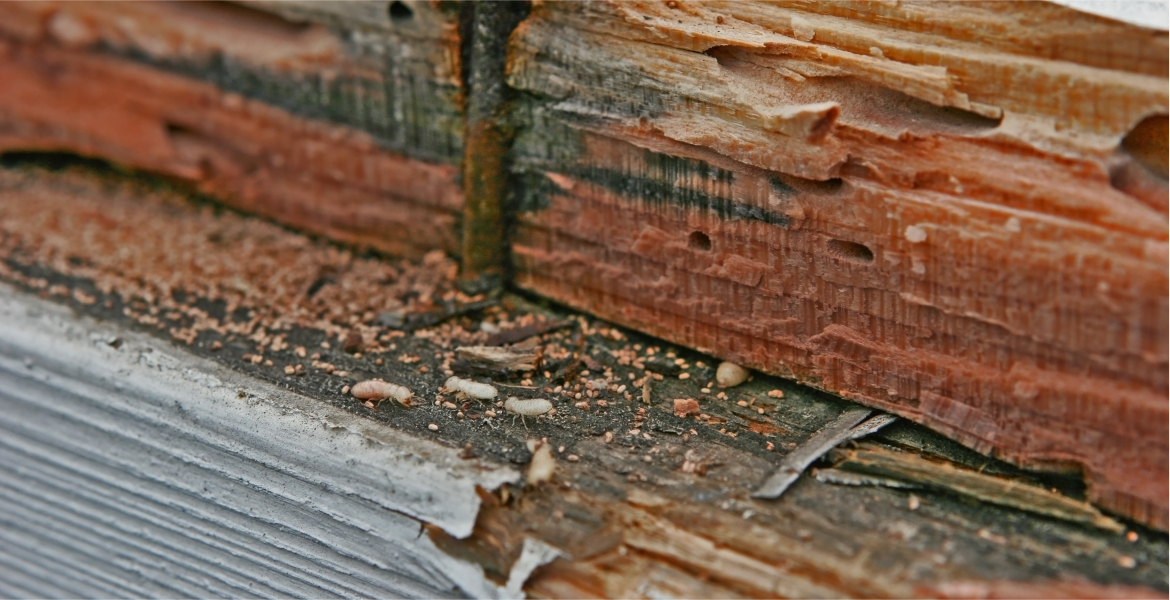
Subterranean termites, the most common termites in Central Texas, live in the soil and build pencil-width mud tubes up the foundation or slab to reach wood. Damaged wood is rough inside and packed with soil. You will not find sawdust piles from subterranean termites.
Why the Difference Matters
The treatments are not the same. Carpenter ants need the parent colony and satellite nests found and treated, along with the moisture problems that attracted them. Termites need a colony-level termite treatment and ongoing protection such as bait stations and monitoring. Spraying the insects you can see does not solve either problem.
Termite damage is also more serious over time, since termites actually eat the wood. If there is any chance you are looking at termites, get an inspection sooner rather than later.
What to Do If You Find Swarmers
- Save a few in a zip-top bag or jar so they can be identified
- Vacuum up the rest and note where they appeared
- Do not spray or seal the area before an inspection
- Call for an inspection, especially if you see mud tubes or damaged wood
If you are seeing sawdust and large black ants, read more about carpenter ant control. If you are seeing mud tubes, wings, or swarmers, see our guides to identifying termites and termite swarmers, or our termite treatment services.
Not sure what you found? Call 830-777-CAMO (2266). We identify the insect at every inspection, because the right treatment depends on it.