When most homeowners call a mosquito control company, they have one question in mind: can you come spray my yard? What they often do not realize is that there are several different treatment methods available, and they are not interchangeable. Each one works differently, has different strengths and limitations, and is best suited for different situations.
This post breaks down the most common professional mosquito treatment options so you can have an informed conversation with your pest control provider — and choose the approach that actually fits your property, your family, and your budget.
Method 1: Barrier Spray Treatments
Barrier spray is the most widely used professional mosquito treatment for residential properties, and for most yards in the New Braunfels area, it is the right choice.
A barrier spray involves applying a liquid insecticide to the vegetation, structures, and harborage areas around your property — the places where adult mosquitoes rest during the day. This includes shrubs, ornamental plants, the undersides of leaves, areas around the base of the home, fence lines, and any dense vegetation along the property perimeter.
The product kills mosquitoes on contact and then provides residual protection as long as it remains on the treated surfaces — typically 21 to 30 days, depending on rainfall and the specific product used. As new adult mosquitoes emerge or migrate into your yard and land on treated surfaces, they are also eliminated.
Barrier spray does not treat standing water or larval breeding sites directly. That is why it works best when combined with standing water elimination, as we covered in our yard preparation guide.
Best for: Most residential properties in New Braunfels, Seguin, San Marcos, Canyon Lake, Cibolo, La Vernia, Garden Ridge, and surrounding areas. Standard suburban and semi-rural lots with grass, shrubs, and typical landscaping.
Frequency: Every 21 to 30 days during peak season — typically May through October.
What to expect: A noticeable reduction in mosquito activity within 24 to 48 hours of treatment.
Method 2: Mosquito Fogging
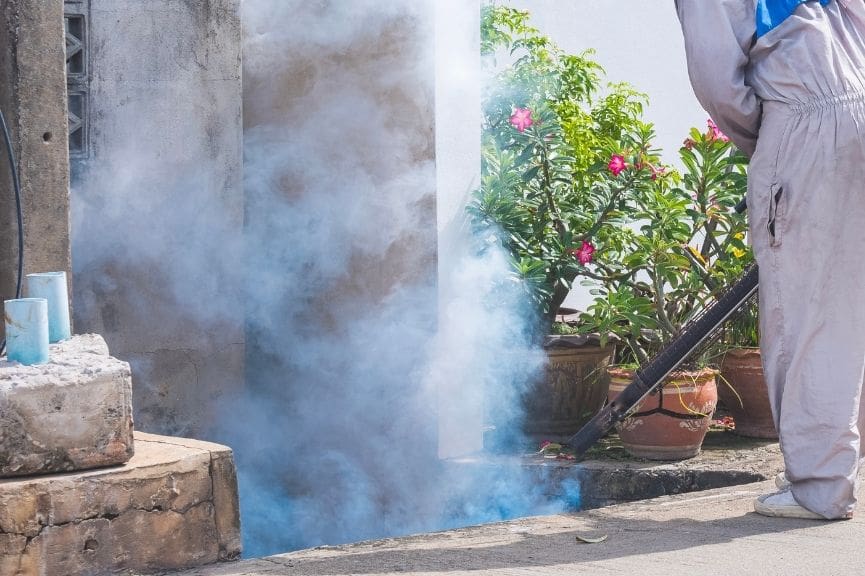
Fogging involves dispersing a very fine mist or fog — either thermally or through a cold fogger — across a large area. It is fast, it covers significant ground quickly, and it delivers an immediate knockdown of adult mosquito populations in the treated zone.
The important distinction between fogging and barrier spray is residual. Fogging knocks down the mosquitoes that are present and airborne at the time of treatment. It does not leave a lasting residue on vegetation the way a barrier spray does. That means the protection is real but short-lived — typically 24 to 72 hours.
Fogging also does not treat resting sites or breeding areas. It is not designed to suppress mosquito populations over time; it is designed to reduce them quickly for a specific window.
Best for: Outdoor events — parties, weddings, graduations, cookouts, or any gathering where you need the yard to be as comfortable as possible for a specific date. Fogging is typically scheduled 24 to 48 hours before the event.
Frequency: As needed, based on events or severe short-term infestation.
What to expect: Immediate and dramatic reduction in flying mosquito populations. Results are temporary and do not extend protection week to week.
Method 3: Mosquito Misting Systems
A mosquito misting system is a permanent or semi-permanent installation of nozzles placed at intervals around the perimeter of your property. The nozzles are connected to a reservoir of insecticide and set to release brief automated bursts — called misting cycles — at programmed intervals throughout the day, typically at dawn and dusk when mosquito activity is highest.
Misting systems provide the most consistent, automated protection available for residential properties. Once installed, they operate without you having to schedule service calls or think about reapplication schedules. The reservoir is refilled periodically by a service provider.
The trade-off is cost. Misting systems have a higher upfront installation cost than a spray or fogging program. They also require ongoing product refills and occasional maintenance. For properties with significant ongoing mosquito pressure — large lots, waterfront properties, homes adjacent to the river corridor or creek beds — the convenience and consistency often justify the investment.
Best for: High-infestation properties, larger estates, vacation rentals, properties near the Guadalupe or Comal River, and homeowners who want season-long automated protection without scheduling recurring service calls.
Frequency: Automated — misting cycles are programmed into the system. Reservoir refills and maintenance as needed.
What to expect: Consistent, ongoing protection throughout the season with minimal hands-on management.
Method 4: Larvicide Treatments
Larvicide treatments are not a replacement for any of the above — they are a complementary treatment that targets mosquitoes at an earlier stage of their lifecycle. Rather than killing adult mosquitoes, larvicides are applied to standing water that cannot be drained, killing mosquito larvae before they develop into biting adults.
Bti-based products (Bacillus thuringiensis israelensis) are a commonly used biological larvicide that is safe for fish, wildlife, pollinators, and pets when applied correctly. These products are applied to ornamental ponds, water features, drainage areas, and other sources of standing water that cannot be removed.
For properties near the river corridor or those with low-lying terrain that holds water after rain, adding larvicide treatment to a barrier spray program significantly improves results.
Best for: Properties with water features, retention areas, drainage ditches, or consistent pooling after rain.
Frequency: Typically reapplied every 30 days or after significant rain events wash away the product.
What Camo Pest Control Recommends for New Braunfels Properties
Every property is different, and the right treatment depends on the size of your yard, your proximity to natural water sources, how you use your outdoor space, and your goals for the season.
That said, here is what we typically recommend for different situations in the Comal County area:
Most suburban yards in New Braunfels: A recurring barrier spray program, applied every 21 to 30 days from May through October. This is the most cost-effective option for typical residential properties and delivers consistent season-long results.
Properties near the Guadalupe or Comal River: A barrier spray program combined with larvicide treatments for drainage areas and water features. The additional breeding habitat near waterways requires more comprehensive coverage.
Event coverage: A one-time fogging treatment scheduled 24 to 48 hours before the event date. This can be added on to an existing service program or booked as a standalone service.
Large properties or vacation rentals: A misting system installation provides the most reliable hands-off protection for properties where consistent coverage is a priority.
Our technicians assess every property before making a recommendation. There is no single-size solution, and we do not sell programs that do not fit your situation.
Contact Camo Pest Control for pest control in New Braunfels to schedule a property assessment.