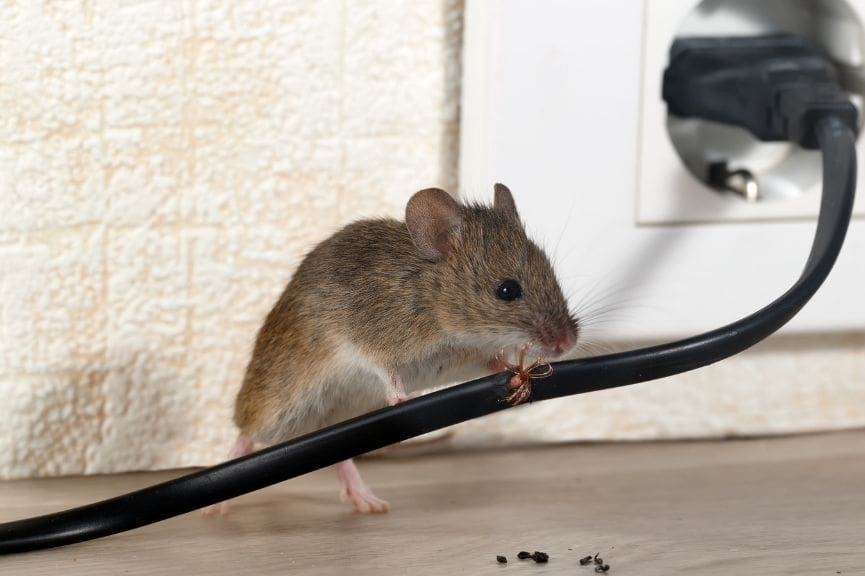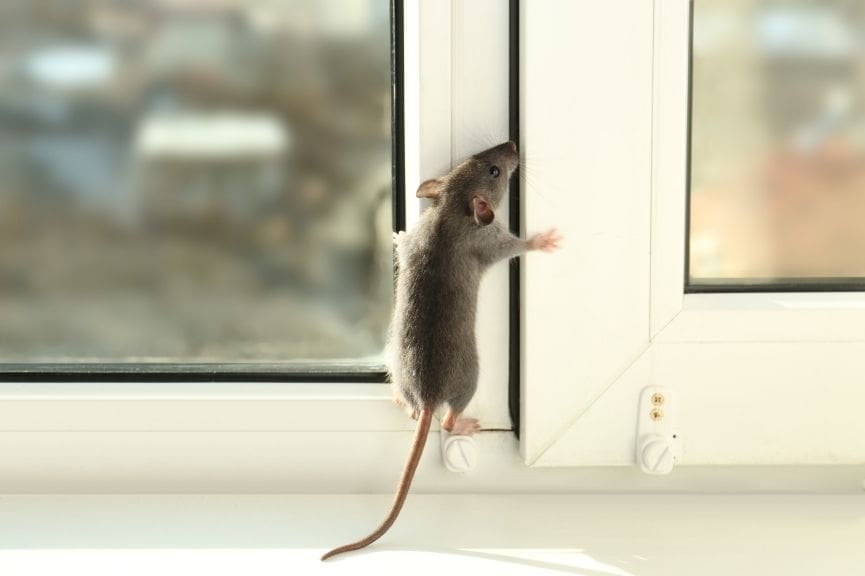
You heard something moving above the ceiling last night. Or you found droppings behind the cereal boxes. Either way, the first question is the same one everybody asks: is this mice or is this rats?
It matters more than most people realize. The two animals behave differently, enter homes through different openings, nest in different parts of the structure, and respond to completely different trapping approaches. Getting the identification right is the difference between resolving the problem in two weeks and chasing it for three months.
Here is how to tell them apart without needing to see one.
Start With the Droppings
This is the fastest and most reliable indicator, and you will almost always find droppings before you see the animal.
Mouse droppings are about the size of a grain of rice, roughly a quarter inch long, dark, and pointed at both ends. You will typically find them scattered in high numbers, since a single mouse produces dozens per day. Common locations are the backs of cabinets, pantry shelves, under sinks, along baseboards, and in the garage.
Rat droppings are noticeably larger, from half an inch to three quarters of an inch, and shaped more like a capsule. Roof rat droppings have pointed ends and are found in attics and along beams. Norway rat droppings are blunt at the ends and turn up near foundations, sheds, and burrow openings.
If you are looking at something the size of a rice grain, you have mice. If it looks closer to a raisin, you have rats.
Fresh droppings are dark and slightly soft. Older ones are gray, dry, and crumble when disturbed. That difference tells you whether the activity is current or historical.
What is the difference between mouse droppings and rat droppings? Mouse droppings are about a quarter inch long, roughly the size of a grain of rice, with pointed ends. Rat droppings are half an inch to three quarters of an inch long and shaped like a capsule. Size is the clearest indicator.
Listen to the Sound
The noises are genuinely different and most homeowners can distinguish them once they know what to listen for.
Mice make light, fast, scratching sounds. The noise is often inside walls rather than overhead, and it comes in short bursts. Some people describe it as a scribbling or rustling sound. Because mice are small, the sound carries less weight to it.
Rats are louder and heavier. Homeowners describe running, scrambling, thumping, and sometimes rolling or dragging sounds. Rat noise is usually overhead in the attic or ceiling rather than in the walls, and it is unmistakably the sound of something with body weight moving around.
Both are nocturnal, so activity typically starts shortly after dark and picks up through the night. If you are hearing noise during the day, that often means the population is large enough that daytime movement is happening out of necessity.
Check the Entry Hole
If you find a chewed opening, its size narrows things down immediately.
A mouse can get through a gap the size of a dime. If you can fit a pencil into an opening, a mouse can use it. Mouse entry holes are small, clean, and often around a half inch across.
A rat needs an opening roughly the size of a quarter, though they routinely enlarge smaller gaps by chewing. Rat entry holes are bigger, rougher, and frequently show gnaw marks radiating out from the opening.
Where They Nest Tells You a Lot
Mice nest close to their food source, usually within twenty to thirty feet. That means wall voids near kitchens, cabinet interiors, pantries, stored boxes, and insulation in accessible spots. Mouse nests are made from shredded paper, fabric, and insulation packed into a tight ball.
Roof rats nest high. Attics, soffits, the tops of wall cavities, and outside in trees, dense vines, and along fence lines. If your noise is overhead and the droppings are on attic beams, roof rats are the likely answer. Roof rats are the more common rat species across Central Texas.
Norway rats nest low. Burrows in the yard, under slabs, sheds, decks, driveways, and woodpiles. Openings are typically two to four inches across and appear near the foundation.
The Behavior Difference That Trips People Up
Here is the practical detail that explains why the traps in your garage have not caught anything.
Mice are curious. A new object in their environment gets investigated, often the same day. That is why mouse traps frequently produce results within twenty four hours of being set correctly.
Rats are the opposite. They avoid unfamiliar objects in their established territory, a behavior called neophobia. A brand new trap sitting in a rat runway can go untouched for several days while the rats simply route around it. Homeowners often conclude they no longer have a problem, when in reality the rats are just working around the new obstacle.
This is the single biggest reason DIY rat trapping fails and DIY mouse trapping sometimes works.
Why are rats harder to trap than mice? Rats exhibit neophobia, meaning they avoid unfamiliar objects in their territory. A new trap can sit untouched for days. Mice are curious and will investigate a new object quickly, which is why mouse traps often work faster.
Quick Reference
| Mice | Rats | |
|---|---|---|
| Droppings | Quarter inch, rice shaped, pointed | Half to three quarter inch, capsule shaped |
| Sound | Light, fast scratching, in walls | Heavy running and thumping, overhead |
| Entry gap | Size of a dime | Size of a quarter or larger |
| Nesting | Wall voids, cabinets, near food | Attics and soffits, or burrows near foundation |
| Behavior | Curious, investigates new objects | Cautious, avoids new objects for days |
Why Correct Identification Changes the Treatment
When our technicians inspect a home in New Braunfels, the species determines where we start. A suspected roof rat job begins at the roof line, checking soffits, vents, fascia gaps, and any tree limbs bridging to the structure. A mouse job starts at ground level, checking weep holes, garage door corners, utility penetrations, and door sweeps.
Trap type, bait selection, placement strategy, and the exclusion materials we use all change based on which animal we are dealing with. Treating a rat problem like a mouse problem wastes weeks.
If you are not sure what you have, that is completely normal and it is part of what an inspection is for. We identify the species, find the entry points, and build the treatment around what is actually happening in your home.
Learn more about our rodent control services in New Braunfels, or read the specifics on rat control and mouse control.
Call Camo Pest Control at 830-777-CAMO (2266) to schedule an inspection.